
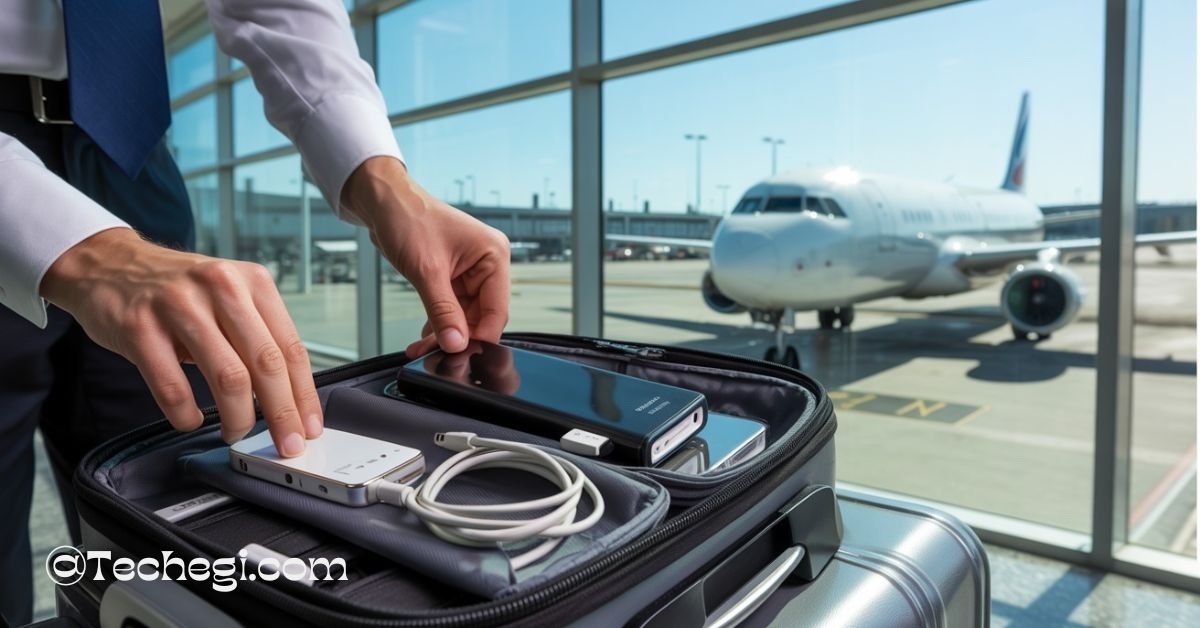
Yes, you can take a phone charger on a plane. Standard phone chargers, such as charging cables and wall adapters, are generally allowed by airlines and airport security. Millions of travelers carry them every day without any issues.
Many travelers worry about chargers at airports because airline rules around electronics, batteries, and security screening can be confusing. Stories about items being confiscated—especially power banks—often make people unsure about what is actually allowed and where to pack it.
In this article, you’ll learn exactly how you can take a phone charger on a plane, what types of chargers are permitted, where to pack them, and what rules apply to different kinds of chargers, including portable power banks.
We’ll also briefly explain the difference between carrying a phone charger in carry-on luggage versus checked baggage, so you can pack correctly and avoid delays or problems at airport security.
Are Phone Chargers Allowed on Planes?
Yes, phone chargers are allowed on planes. Airlines and airport security permit passengers to bring standard phone chargers because they do not pose a safety risk. This means travelers do not need special permission to carry a regular phone charger when flying.
When asking can you take a phone charger on a plane, it helps to understand that not all chargers are the same. The most commonly allowed types include charging cables, wall plug adapters, USB chargers, and fast-charging adapters. These chargers do not store electricity on their own, which is why they are widely accepted on flights.
However, there is an important difference between cable chargers and portable chargers, also known as power banks. Cable chargers simply transfer power from a wall outlet or USB port, while power banks contain lithium batteries that store energy. Because of this, power banks are subject to stricter airline rules and usually must be carried in hand luggage only.
Can You Take a Phone Charger in Carry-On Luggage?
Yes, you can take a phone charger in carry-on luggage, and this is the option most airlines recommend. According to TSA and airline safety rules, standard phone chargers such as cables and wall adapters are fully allowed in carry-on bags. There are no limits on how many basic chargers you can carry for personal use.
Carry-on luggage is considered the safest place for chargers, especially if they include sensitive components or batteries. If a charger overheats or becomes damaged, cabin crew can respond immediately, which is why airlines prefer electronics to stay in the cabin rather than the cargo hold.
When passing through airport security, phone chargers usually do not need to be removed from your bag. However, if a charger looks damaged, modified, or unusual, security staff may inspect it more closely. Keeping chargers untangled and easy to see can help avoid delays.
Best practices for packing chargers in hand luggage include:
- Store chargers in a small pouch or organizer
- Avoid packing damaged or frayed cables
- Keep power banks clearly labeled with capacity
- Place chargers near the top of your bag for easy screening
Can You Put a Phone Charger in Checked Luggage?
Yes, phone chargers are allowed in checked luggage as long as they do not contain a lithium battery. Basic charging cables and wall plug adapters can safely be placed in checked bags without violating airline rules.
Airlines discourage lithium batteries in checked luggage because they carry a small risk of overheating or catching fire. In the cargo hold, a fire can be difficult to detect and control, which is why portable chargers and power banks are usually prohibited in checked baggage.
It is allowed to place a phone charger in checked luggage when:
- The charger does not store power
- It is a simple cable or wall adapter
- It shows no signs of damage
It is not allowed when:
- The charger is a power bank or portable battery
- The charger contains a lithium-ion battery
- The airline specifically restricts battery-powered devices
For safety and convenience, travelers are generally advised to keep chargers—especially battery-based ones—in their carry-on luggage.
Rules for Power Banks and Portable Phone Chargers on Planes
Understanding the rules for power banks is important because they are treated differently from regular phone chargers. A regular charger only transfers electricity from a power source, while a power bank stores energy using a lithium-ion battery. Because of this stored power, power banks are subject to stricter airline safety rules.
Lithium-ion batteries can overheat if damaged or poorly manufactured, which is why airlines closely regulate them. To reduce risk, most airlines require power banks to be carried in the cabin, where any issue can be handled quickly by the crew.
Airlines usually measure battery size in watt-hours (Wh). In most cases:
- Power banks up to 100 Wh are allowed in carry-on luggage
- Power banks between 100 Wh and 160 Wh may require airline approval
- Power banks above 160 Wh are generally banned on passenger flights
Power banks may be restricted or banned if they:
- Are placed in checked luggage
- Do not show their battery capacity
- Appear damaged, swollen, or overheated
- Exceed airline-approved limits
If you are unsure about your power bank, checking your airline’s battery policy before flying is the safest approach.
TSA Rules for Phone Chargers (USA Flights)
For flights departing from or within the United States, TSA rules apply at airport security checkpoints. TSA guidelines are designed to balance passenger convenience with safety and are generally straightforward when it comes to phone chargers.
Phone chargers are allowed through airport security, including charging cables, wall adapters, and USB chargers. These items can remain in your bag unless a TSA officer asks for closer inspection.
For domestic flights, TSA rules are consistent across all U.S. airports. For international flights departing from the U.S., TSA screening still applies at the departure airport, even though additional rules from the destination country or airline may apply later.
If TSA flags your charger, it is usually because:
- The charger looks damaged or modified
- A power bank is packed in checked luggage
- The battery capacity is unclear or exceeds limits
In most cases, TSA officers will explain the issue and may ask you to remove or surrender the item if it does not meet safety standards.
Airline Rules: Can You Take a Phone Charger on International Flights?
Yes, you can take a phone charger on international flights, but the rules can differ slightly compared to domestic travel. While most airlines follow global aviation safety standards, international flights may involve additional regulations depending on the airline and country.
The main difference between domestic and international flights is enforcement. Domestic flights usually follow one national authority, while international flights may involve multiple aviation regulators. This can affect how strictly battery rules are applied, especially for power banks.
Airline rules can change by country. For example:
- U.S. airlines generally follow TSA and FAA guidelines
- UK and EU airlines follow similar lithium battery rules, often aligned with EASA standards
- Middle Eastern airlines may enforce stricter checks on battery capacity and labeling
Although regular phone chargers are allowed everywhere, power bank limits and approval requirements can vary. This is why checking your airline’s official website before flying is important. Airline websites provide the most accurate and up-to-date information, helping you avoid surprises at the airport.
Can You Use a Phone Charger on a Plane?
In many cases, yes, you can use a phone charger on a plane, depending on the aircraft and seat type. Modern airplanes often include built-in charging options for passengers.
Some planes offer USB ports, usually located under the seat or in the armrest. Others provide power outlets, which can support wall chargers. USB ports are more common on short and medium-haul flights, while power outlets are often found on long-haul aircraft.
However, chargers may not work in-flight if:
- The plane does not have charging ports
- The power system is temporarily disabled
- USB ports deliver low power for fast charging
To stay prepared, keep your phone fully charged before boarding and carry a compliant power bank in your carry-on bag. Using airplane mode and reducing screen brightness can also help preserve battery life during the flight.
Can You Take Fast Chargers, USB-C, or Laptop Chargers on a Plane?
Yes, fast chargers, USB-C phone chargers, and laptop chargers are allowed on planes. Airlines focus primarily on safety and battery regulations rather than the type or speed of your charger.
Fast charging adapters work by delivering higher power to your device, but since they do not store electricity themselves, they are treated like any regular wall adapter. You can safely pack them in either carry-on or checked luggage.
USB-C phone chargers are also permitted on flights. Like other cables, they do not pose a risk and can be screened along with other electronics at security.
Laptop chargers are allowed as well. While they are larger, they do not usually trigger restrictions unless they have built-in batteries or appear damaged. When using laptop chargers on the plane, ensure the voltage is compatible with the aircraft outlet if applicable.
Safety considerations:
- Inspect chargers for frayed wires or damage before traveling
- Avoid carrying counterfeit or modified chargers
- Keep all charging equipment organized for easy inspection
Common Airport Security Issues with Phone Chargers
Although phone chargers are generally allowed on planes, travelers occasionally face security issues at airports. Being aware of these can save time and stress.
Why chargers sometimes get stopped at security:
- Security staff may be cautious with items containing batteries
- Suspicious-looking cables or adapters may be pulled aside
Damaged cables and exposed wires are a common reason for chargers being flagged. Security officers may ask you to discard them to prevent fire hazards.
Oversized power banks are another frequent issue. Power banks above airline-approved watt-hour limits can be confiscated if carried in checked luggage or without proper approval.
Tips to avoid delays at airport checkpoints:
- Keep chargers organized and untangled
- Clearly label power banks with capacity
- Pack cables and adapters in an accessible pouch
- Inspect chargers for visible damage before traveling
Following these precautions ensures a smooth security check and reduces the risk of losing your chargers at the airport.
Tips for Traveling with Phone Chargers on a Plane
Traveling with phone chargers can be simple and stress-free if you follow a few practical tips:
- Pack chargers smartly: Use a small pouch or organizer to keep cables and adapters untangled and easy to access.
- Label cables: Writing your name or labeling different cables prevents confusion, especially if you carry multiple devices.
- Carry multiple chargers safely: Keep extra chargers or adapters in your carry-on, but avoid overpacking to prevent damage.
- Use travel-friendly accessories: Consider compact adapters, multi-port USB chargers, or foldable cables to save space and weight in your bag.
These small precautions help ensure your electronics stay safe and you pass through airport security smoothly.
What Happens If You Bring a Restricted Charger on a Plane?
If you bring a restricted charger or power bank that violates airline rules, airport authorities may take action:
- Confiscation: The charger may be taken at security if it does not comply with regulations.
- Options for travelers: Some airports allow you to discard the item, return it to your car, or sometimes check it if rules permit.
- Airline and airport decisions: Different airlines may enforce battery and charger rules differently, especially for international flights.
How to avoid losing your charger: Always check airline and TSA guidelines before traveling, keep power banks within approved limits, and pack all electronics in good condition.
Can You Take a Phone Charger on a Plane? (Quick Summary)
For travelers who want a fast overview:
- Regular chargers are allowed in carry-on and checked luggage.
- Power banks must be in carry-on luggage only and follow airline watt-hour limits.
- Damaged or oversized chargers may be confiscated at security.
- Carry-on is the safest option to ensure chargers are accessible during the flight.
- Check airline rules before international flights to avoid surprises.
Following these tips makes traveling with chargers simple, safe, and stress-free.
Frequently Asked Questions (FAQs)
1. Can you take a phone charger on a plane in hand luggage?
Yes, standard phone chargers and approved power banks are allowed in carry-on luggage.
2. Can you take a phone charger on a plane in checked baggage?
Yes, basic charging cables and wall adapters can go in checked bags. Power banks, however, must stay in carry-on luggage.
3. Are phone chargers allowed on international flights?
Yes, but rules for power banks may vary slightly depending on the airline and country. Always check your airline’s policy before flying.
4. Can I bring more than one phone charger on a plane?
Yes, there is no limit on the number of standard phone chargers for personal use.
5. Are phone chargers allowed through airport security?
Yes, chargers pass through security screening. Power banks must be in carry-on luggage and within approved capacity limits.
Conclusion: Can You Take a Phone Charger on a Plane?
In summary, you can take a phone charger on a plane without any problems, whether it’s a regular cable, wall adapter, USB-C charger, or laptop charger. The key is understanding the rules for portable chargers or power banks, which must be carried in your hand luggage and comply with airline watt-hour limits.
By keeping chargers organized, labeling cables, and following airline and TSA guidelines, you can travel with confidence, avoid delays at security, and ensure your devices stay powered throughout your journey. Remember, carry-on luggage is the safest place for chargers, and checking airline rules—especially for international flights—will help you stay fully compliant and stress-free.
Travel smart, pack carefully, and your phone will stay charged wherever your flight takes you.