
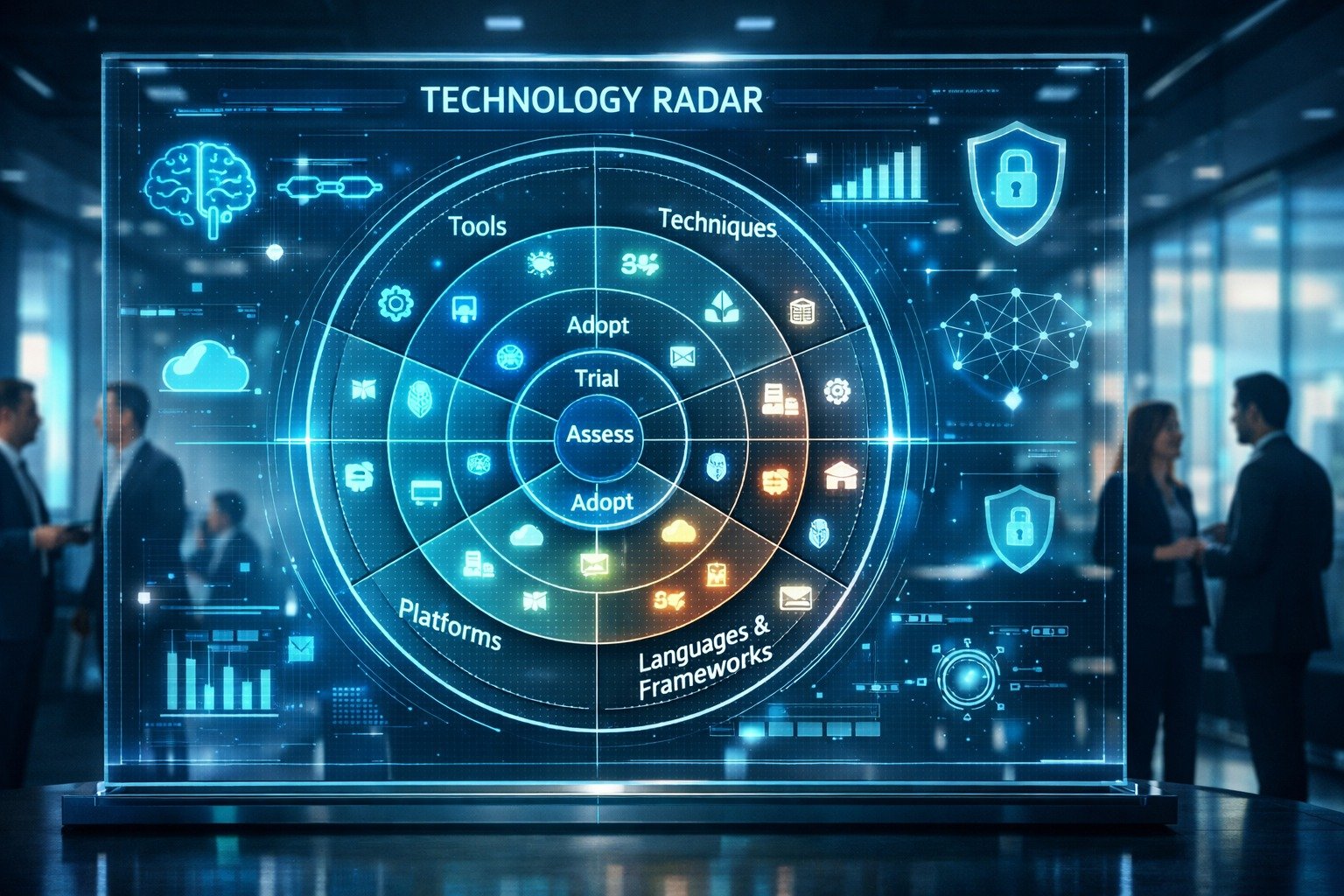
Introduction — What is a Technology Radar?
In today’s fast-moving digital world, organisations are constantly exposed to new tools, platforms, frameworks, and emerging innovations. The challenge is not just discovering new technologies — it is deciding which ones truly matter. This is where a technology radar becomes essential.
A technology radar is a strategic framework used to track, assess, and visualise emerging technologies and trends. It helps organisations evaluate tools, techniques, platforms, and programming languages based on their maturity, relevance, and risk level. Instead of chasing every new trend, companies use a technology radar to make structured, evidence-based adoption decisions.
The concept is simple but powerful. Technologies are placed into categories based on how ready they are for implementation and how valuable they may be to the organisation. This visual approach provides clarity and encourages informed discussions between engineering leaders, product teams, innovation managers, and executives.
A well-designed technology radar reduces uncertainty. It transforms complex technology landscapes into understandable insights, helping organisations adopt innovation with confidence rather than confusion.
Why Technology Radar Matters in the Digital Age
Digital transformation has accelerated across industries. Artificial intelligence, cloud computing, cybersecurity innovations, data platforms, and automation tools are evolving at unprecedented speed. In such an environment, making the wrong technology investment can be costly. A technology radar provides structure in this chaos.
One of the primary reasons organisations rely on a technology radar is clarity. When dozens of new technologies appear every year, teams need a reliable method to filter noise from opportunity. The radar acts as a strategic lens, highlighting what deserves attention and what should be approached with caution.
Another critical advantage is risk management. Adopting immature or unstable technology can lead to operational disruption. On the other hand, ignoring emerging innovation can make a company less competitive. A technology radar balances these risks by categorising technologies based on readiness and organisational fit.
In addition, a technology radar supports innovation planning. Instead of reacting to trends, companies can proactively plan adoption cycles, pilot projects, and long-term investments. This improves budgeting accuracy and aligns technical decisions with business strategy.
Ultimately, in the digital age, decision speed matters — but informed decision speed matters more. A technology radar ensures that innovation is guided by insight, not impulse.
History & Origin of the Technology Radar Concept
The idea of mapping technologies based on maturity and relevance gained significant recognition through Thoughtworks, a global technology consultancy. Although organisations had long evaluated tools informally, Thoughtworks formalised the concept with its well-known Technology Radar publication.
The Thoughtworks Technology Radar was introduced as a way to share insights from experienced technologists across global teams. It provided a structured format for evaluating tools, techniques, platforms, and languages. Over time, this radar model became widely adopted beyond Thoughtworks, influencing enterprise IT strategies and innovation frameworks worldwide.
The original intent was not to predict the future, but to document collective experience. Teams would gather and discuss technologies they had tested, piloted, or evaluated. These discussions were translated into radar placements, offering guidance to others facing similar decisions.
As the digital ecosystem expanded, the technology radar evolved from a consultancy publication into a widely used strategic tool. Today, startups, enterprises, government organisations, and innovation labs adapt the model to suit their own needs.
The strength of the technology radar lies in its simplicity. It does not claim absolute authority. Instead, it provides structured perspective — a shared understanding of where technologies stand at a specific moment in time.
Core Components of a Technology Radar
A technology radar is built around two foundational structures: quadrants and rings. Together, these components create a visual framework that is both intuitive and analytically useful.
Radar Quadrants
Quadrants divide technologies into categories based on their functional role. While organisations may customise categories, the most common quadrants include:
- Tools
- Techniques
- Platforms
- Languages & Frameworks
Tools refer to software or utilities that assist development or operations. Techniques represent methods or practices, such as DevOps approaches or testing strategies. Platforms include infrastructure or ecosystem solutions like cloud services. Languages and frameworks cover programming technologies used to build systems.
This categorisation prevents confusion. It ensures that comparisons happen within relevant groups rather than across unrelated technology types.
Radar Rings
Rings represent the maturity and recommendation level of each technology. The standard ring model includes:
- Adopt: Proven technologies ready for broad use.
- Trial: Technologies worth piloting in controlled environments.
- Assess: Emerging tools requiring further research.
- Hold: Technologies not recommended for adoption at present.
These rings create strategic guidance. Instead of simply listing technologies, the radar communicates action.
Together, quadrants and rings transform abstract trends into actionable insight.
How the Technology Radar Works (Step-by-Step)
A technology radar is not a static document. It is the result of a structured, collaborative evaluation process.
Identification of Technologies
The first step involves collecting signals from multiple sources. These signals may come from internal teams, industry conferences, vendor research, academic publications, open-source communities, or pilot projects. The goal is broad discovery.
Organisations often encourage engineers and innovation leaders to submit technologies for consideration. This ensures diverse input rather than top-down selection.
Scoring & Selection
Once technologies are identified, evaluation begins. Teams assess factors such as maturity, stability, business value, integration complexity, community support, and risk exposure.
Placement within the radar depends on evidence, not hype. For example, a promising but unproven tool may enter the “Assess” ring rather than “Trial.” Mature technologies with strong case studies may move into “Adopt.”
This discussion-based scoring process encourages healthy debate and shared learning.
Visual Representation
The visual layout of a technology radar resembles a circular chart divided into quadrants and rings. Technologies appear as “blips” placed according to category and maturity.
This visualisation makes complex information easy to understand at a glance. Decision-makers can quickly identify priority technologies and areas of caution.
Updating the Radar
A technology radar must evolve. Many organisations update it twice a year. Regular updates reflect new learnings, successful pilots, or changing industry conditions.
Without updates, a radar loses relevance. Continuous revision keeps it aligned with reality.
Example: Thoughtworks Technology Radar Explained
The Thoughtworks Technology Radar remains one of the most recognised implementations of this framework. It serves as a public snapshot of the global technology landscape from the perspective of experienced practitioners.
The radar is structured into four quadrants: Techniques, Tools, Platforms, and Languages & Frameworks. Within each quadrant, technologies are placed into rings representing Adopt, Trial, Assess, or Hold.
For example, a widely validated development practice may appear in the Adopt ring, while an experimental AI framework might be in Assess. The placement reflects real-world experience rather than theoretical potential.
Industries ranging from financial services to healthcare and retail use insights from the Thoughtworks Technology Radar. Technology leaders, CTOs, engineering managers, and innovation strategists rely on it to inform decisions.
The radar does not instruct organisations blindly. Instead, it stimulates discussion. Teams use it as a starting point for evaluating their own context.
Its popularity demonstrates that a structured approach to technology evaluation is both practical and powerful.
Use Cases & Benefits of a Technology Radar
A technology radar supports strategic clarity across multiple organisational functions.
For strategic decision-making, it provides leadership with a visual summary of where the technology ecosystem stands. This improves alignment between technical and business teams. Instead of subjective opinions, discussions are grounded in structured evaluation.
In investment planning, the radar guides resource allocation. Technologies in the Adopt ring may receive budget for scaling, while those in Trial may receive limited pilot funding. This reduces financial waste.
Risk management is another major benefit. By identifying technologies that should be placed on Hold, organisations avoid unnecessary instability. Simultaneously, by highlighting emerging trends in Assess, they avoid falling behind competitors.
Innovation prioritisation becomes easier when teams can visualise opportunity areas. Procurement departments can also use the radar to evaluate vendor solutions against internal maturity standards.
Overall, the technology radar transforms scattered technology decisions into a coherent, repeatable strategy.
How to Build and Implement Your Own Technology Radar
Creating a technology radar requires thoughtful planning rather than copying another organisation’s model.
The first step is defining strategy and scope. Determine whether the radar will focus on software engineering, enterprise IT, data platforms, or the entire digital ecosystem. Clear boundaries prevent overload.
Next, collect technology signals. Encourage internal submissions and monitor external sources. Diversity of input improves accuracy.
After collection, group technologies into appropriate quadrants. Then conduct structured discussions to determine ring placement. Transparency in evaluation criteria strengthens credibility.
Visualise the radar clearly. Digital tools can assist, but clarity matters more than design complexity.
Finally, establish a review cycle. Regular reassessment ensures the radar reflects real progress. Without updates, it risks becoming decorative rather than strategic.
When implemented carefully, a technology radar becomes a living governance tool rather than a one-time report.
Technology Radar Examples Across Industries
Different industries adapt the technology radar concept to their unique challenges.
In software development, radars guide framework adoption and architectural patterns. Engineering teams use them to standardise tools across global offices.
Enterprise IT departments apply technology radars to infrastructure planning. Cloud migration strategies, cybersecurity frameworks, and data governance tools are assessed through radar models.
Innovation departments use radars to monitor emerging technologies such as AI, blockchain, IoT, and automation. This supports long-term research and experimentation.
Procurement and sourcing teams adapt the radar to evaluate vendor maturity. Instead of reacting to marketing claims, they compare solutions using structured criteria.
Product management teams use radars to understand enabling technologies that may shape product roadmaps.
Across industries, the technology radar serves as a bridge between exploration and execution.
Best Practices & Common Mistakes to Avoid
To ensure effectiveness, organisations must approach a technology radar carefully.
One best practice is maintaining regular updates. A stagnant radar quickly becomes irrelevant. Technology evolves rapidly, and so must evaluation frameworks.
Objectivity is equally important. Placement decisions should be evidence-based, not influenced by vendor relationships or internal politics. Structured scoring criteria help maintain fairness.
Another best practice is tailoring the radar to organisational context. A startup’s radar will differ from a multinational enterprise’s radar. Blindly copying external models can mislead decision-making.
Common mistakes include overloading the radar with too many technologies or treating it as a marketing document. A technology radar should guide decisions, not impress audiences.
When managed correctly, it becomes a strategic asset rather than a visual accessory.
Future of Technology Radar
The future of the technology radar is evolving alongside digital transformation.
AI-driven analytics may soon automate parts of the evaluation process. Machine learning models can scan research publications, GitHub repositories, and market reports to detect emerging trends in real time.
Real-time dashboards may replace static biannual updates. Continuous monitoring could provide dynamic ring adjustments based on performance data.
Industry-specific radars are also gaining popularity. Healthcare, finance, and manufacturing sectors are developing tailored radar frameworks aligned with regulatory and operational realities.
Sustainability considerations are becoming more prominent. Organisations increasingly evaluate technologies based not only on performance but also on environmental impact.
The technology radar is likely to become more data-driven, interactive, and integrated into enterprise governance systems.
Conclusion
A technology radar is far more than a visual chart. It is a structured approach to navigating the complexity of modern technology landscapes. By categorising innovations into quadrants and rings, organisations gain clarity, reduce risk, and align technical decisions with strategic goals.
From its origins in Thoughtworks to its adoption across industries, the technology radar has proven to be a powerful governance tool. When updated regularly and used thoughtfully, it fosters informed experimentation without reckless adoption.
In a world where technology changes constantly, the ability to evaluate change systematically is a competitive advantage. A well-designed technology radar provides exactly that advantage.
FAQ’s
1. How is a technology radar different from a technology trend report?
A technology radar focuses on evaluation and action. It categorises technologies by maturity and recommendation level, while a trend report often describes trends without structured adoption guidance.
2. Who should be involved in creating a technology radar?
Engineering leaders, architects, product managers, innovation teams, and sometimes procurement or compliance specialists should collaborate to ensure diverse perspectives.
3. Can a technology radar include non-technical innovations?
Yes. Some organisations expand their radar to include process innovations, business models, or regulatory frameworks alongside technical tools.
4. How large should a technology radar be?
There is no fixed size, but clarity is critical. Most effective radars focus on a manageable number of technologies to avoid overwhelming decision-makers.
5. Is a technology radar suitable for startups?
Absolutely. Even small teams benefit from structured evaluation, especially when resources are limited and technology choices have significant impact.
Also read: