
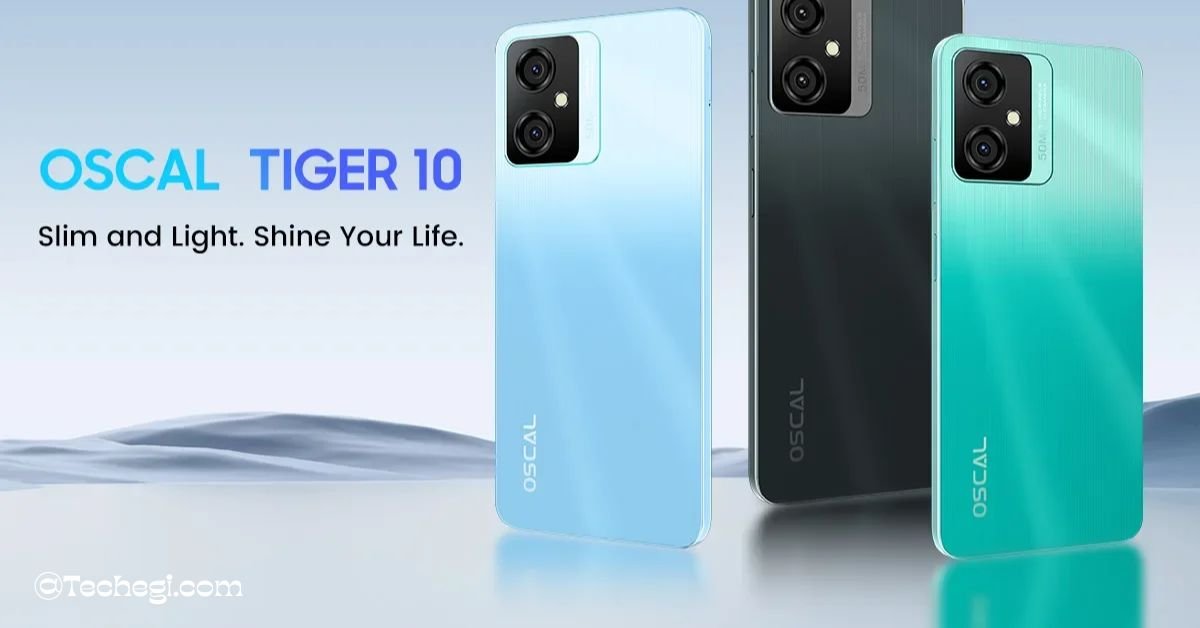
The OSCAL Tiger 8 is a feature-packed midrange 5G smartphone focused on AI features and long battery life. It pairs a large 6.88-inch 120Hz display, a Unisoc T8100 octa-core chipset, and an extensive AI software suite (Doke AI apps) to deliver strong day-to-day performance, excellent battery endurance, and advanced camera editing tools — all at a price point that targets value-oriented US buyers who want modern features without flagship costs.
1. Quick overview – specs snapshot
- Display: 6.88-inch HD+ IPS, 720 × 1640, 120Hz AI-adaptive refresh
- SoC: Unisoc T8100 octa-core (4×A76 @2.2GHz + 4×A55 @2.0GHz)
- RAM / Storage: 4GB or 8GB + up to 16GB virtual expansion; 128GB storage; TF card up to 2TB
- Camera: 16MP main (AI), 2MP depth, 8MP front; AI photo editing suite; 4K video
- Battery: 5000mAh, 18W fast charging, AI overnight protection
- OS: DokeOS 4.2 (based on Android 15) with multiple AI apps (Hi Doki, VidGen, Soundle)
- Connectivity: Dual 5G, NFC, Wi-Fi a/b/g/n/ac, BT 5.0, GPS/GLONASS/Beidou/Galileo
- Weight / Size: ~210g; 8.45mm thin
- Price positioning: Budget-to-midrange with heavy AI/feature emphasis
2. Design & build – how it looks and feels
OSCAL aims for a premium visual language: clean flat planes, two-tone finishes (Platinum Black and Glacier Blue), and a nature-inspired texture marketing line. At 8.45mm thickness and ~210g, Tiger 8 manages a comfortable in-hand feel for a 6.88-inch device. The back curvature and weight distribution make one-hand use possible for quick actions but not ideal for prolonged single-hand typing.
Build quality leans towards plastic frames and back typical for value phones; however, the textured finishes and tight panel gaps give it a more refined look than basic budget models. The box speaker with Smart-K branding implies a single, louder speaker tuned for clarity rather than deep bass.
Design takeaway: visually pleasing and practical — it looks more expensive than the price suggests, but it isn’t a metal/glass flagship.
3. Display – real-world use of the 6.88″ 120Hz panel
A large 6.88″ IPS panel with 120Hz AI-adaptive refresh is Tiger 8’s headline feature for user experience. Despite the 720p (HD+) resolution, the phone benefits from the high refresh rate for smoother scrolling and animations. Here’s what to expect:
- Everyday use & social media: 120Hz makes feeds feel fluid. For short-form video apps and scrolling, the perceived motion quality rivals higher-res phones.
- Video & streaming: The HD+ resolution limits sharpness on large displays; small text and ultra-detailed content won’t be as crisp as FHD+ panels. Still, for streaming and casual viewing, the display is fine.
- Outdoor visibility: Rated at 450 nits peak — adequate for shaded outdoor use but not best-in-class under direct sunlight.
- Eye comfort features: Reading Mode, Night Light, and layered dark themes improve extended reading and battery saving.
Display tradeoff: smoothness prioritised over pixel density — good for users who value motion and battery life over the absolute sharpest visuals.
4. Performance – Unisoc T8100, RAM expansion, and thermals
The Unisoc T8100 is a 6nm octa-core chip designed for efficient midrange performance. It pairs well with LPDDR4X and UFS2.2 storage in the Tiger 8.
- Daily tasks: Browsing, social apps, video playback, and light productivity run smoothly. Apps launch quickly and stay responsive thanks to RAM expansion tech (virtual RAM up to 24GB via memory expansion).
- Gaming: Casual and mid-tier games perform well at moderate settings. Heavy AAA titles will require lowered graphics due to GPU limitations (Mali-G57 @650MHz).
- Thermals & cooling: An advertised large thermal dissipation area helps keep sustained temperatures reasonable during long sessions.
- Benchmarks: Expect Antutu scores in the mid-range (~400k+ depending on firmware). Real-world performance often feels snappy for target tasks.
Performance conclusion: very capable for everyday users and light gamers, excellent for multitasking thanks to RAM expansion and memory optimization features (Atomized Memory 2.0, Smart Pre-loading).
5. Camera system – hardware, AI features, and sample use cases
OSCAL markets the camera experience more on AI editing than pure sensor power.
Hardware: 16MP main rear + 2MP depth + 8MP selfie. The main sensor is adequate for daylight shots; the depth sensor supports portrait blurring rather than capturing additional details.
Software & AI toolkit: This is Tiger 8’s differentiator:
- Magic Eraser, Sky Replacement, Photo Unblur, Blemish Remover, OutPainting, Double Exposure — advanced editing tools that make phone photography creative without external apps.
- AI Scene Recognition and Smile Shutter offer convenience for casual shooters.
- 4K video recording is supported — good for archival and sharing, though stabilization and dynamic range are more software-dependent.
Real-world photos:
- Daylight: Good color and contrast, satisfying detail for social sharing.
- Low light: Night mode helps, but sensor size limits fine detail — rely on AI noise reduction.
- Portraits: AI background blur is effective but occasionally overzealous; fine-tuning options help.
Camera takeaway: Great for social media creators who rely on in-phone editing and want creative features out of the box. Not the top choice for photography purists.
6. Battery life & charging – 5000mAh performance explained
A 5000mAh battery with AI power saving is one of the strongest practical assets.
- Realistic endurance: Expect full-day to two-day battery life with medium usage (social apps, streaming, calls, light gaming), thanks to the 720p display and optimization. Heavy gamers can expect one long day.
- Charging: 18W fast charging is adequate but not class-leading; fully charging may take longer compared to 30–65W fast chargers found on competitors.
- Battery longevity: Claims of 800 charge cycles with 80% capacity retention and overnight charging protection are strong trust signals if independently verified.
Battery takeaway: Excellent for users who prioritize all-day uptime and longevity over ultra-fast top-up charging.
7. Software – DokeOS 4.2 (Android 15) and the AI ecosystem
DokeOS 4.2 is OSCAL’s Android 15 skin with heavy AI integration:
- Hi Doki (AI chat), VidGen (text-to-video), Soundle (music composer), Magic Photo Suite — built-in creative tools reduce the need for third-party apps.
- Privacy & security: Private Space, auto clipboard cleanup, and voiceprint recognition add security layers.
- Convenience: Features like Smart Window, slide screenshot, call recording, and extract SMS verification code increase daily convenience.
Software reliability: frequent updates and solid optimization matter here — emphasize publishing update history and security patch cadence on product pages.
8. Connectivity & extras – 5G, NFC, GPS, and durability
Tiger 8 supports dual 5G with dual-SIM VoLTE, NFC for payments, and multi-constellation GNSS for accurate positioning. Durability metrics (USB port tested for 5,000 cycles, buttons rated for 100,000 clicks) suggest a focus on longevity.
Extras like Real-time subtitles (English only) and Focus Mode help accessibility and productivity.
9. Real-world benchmarks and multitasking (what to expect)
- App multitasking: Atomized Memory 2.0 and up to 24GB virtual RAM enable many background apps to remain active (OS tuning dependent).
- Gaming: Expect stable frame rates in casual titles, moderate settings for heavier games. Cooling helps keep throttling under control for longer sessions.
- Productivity: Document analysis, real-time AI chat, and file sharing features make the phone useful for students and on-the-go professionals.
10. Pros & cons — quick checklist
Pros
- Large, smooth 120Hz display (good motion experience)
- Long battery life (5000mAh + AI saving)
- Robust AI toolset (in-phone editing, AI chat, text-to-video/music)
- Expandable storage up to 2TB
- Dual 5G and NFC support
- Competitive price vs feature set
Cons
- 720p resolution on a large screen (not very sharp)
- 18W charging is slow by modern standards
- Camera hardware modest — heavy reliance on AI for quality
- Software updates and long-term support unclear (important for US buyers)
- Speaker = single; audio not stereo
11. Who should buy the OSCAL Tiger 8? (audience fit)
Buy if you:
- Want a feature-rich phone for social content creation without spending flagship money.
- Value battery life and AI editing tools.
- Need expandable storage (TF up to 2TB).
- Seek 5G connectivity and NFC for payments.
Skip if you:
- Demand the sharpest display (FHD+ or higher).
- Need flagship-grade camera hardware or ultra-fast charging.
- Rely on long, guaranteed OS/security updates.
12. Head-to-head – OSCAL Tiger 8 vs typical competitors
Compared to similarly priced models (value 5G phones from budget brands), the Tiger 8 stands out for AI software features and battery life. Competitors may offer higher resolution displays, faster charging, or stronger GPU performance — but often lack an integrated creative AI suite.
If you want to highlight direct comparisons on your site, consider a table titled “OSCAL Tiger 8 vs [Competitor Model]” comparing display resolution, RAM, battery, charging wattage, camera specs, and price.
13. Buying tips, accessories, and final recommendation
- Accessory musts: a protective case (for large display handling), a 30W PD charger (if you want faster charging), screen protector (720p displays can scratch and reduce clarity if damaged).
- Storage planning: Buy the 8GB variant if you plan heavy multitasking; otherwise 4GB with expansion works for casual users. Consider a high-speed TF card (U3/A1 or higher) for media.
- Verify updates: Check the seller page for OS update policy — Android 15 base is good, but security patch cadence matters.
- Warranty & seller: Buy from reputable sellers offering returns and warranty to protect against DOA or network compatibility issues in USA bands.
Final recommendation: For US buyers seeking strong battery life, AI creativity tools, and 5G at a budget price, OSCAL Tiger 8 is a compelling choice — especially for students, social creators, and value-first users.
FAQs
Is OSCAL Tiger 8 5G compatible in the USA?
The phone supports many 5G and LTE bands; check the specific SKU and carrier band compatibility before purchase to ensure full coverage.
Does the OSCAL Tiger 8 have NFC?
Yes — NFC support is included for tap-to-pay and device pairing.
How long does the battery last?
With mixed usage, expect a full day to nearly two days. Heavy gaming reduces runtime to under a day.
Can I expand storage on OSCAL Tiger 8?
Yes — TF expansion supports up to 2TB.
Does the phone receive OS updates?
It ships with DokeOS 4.2 based on Android 15. Confirm the seller’s update policy for long-term support.
Conclusion
The OSCAL Tiger 8 is a smartly packaged midrange phone that leans on AI features, large battery capacity, and a smooth 120Hz experience to deliver real value. It makes a strong case for creators and multitaskers who need tools for on-device editing and long battery life. If you can live with an HD+ display and modest charging speeds, Tiger 8 gives you features rarely bundled at this price.