
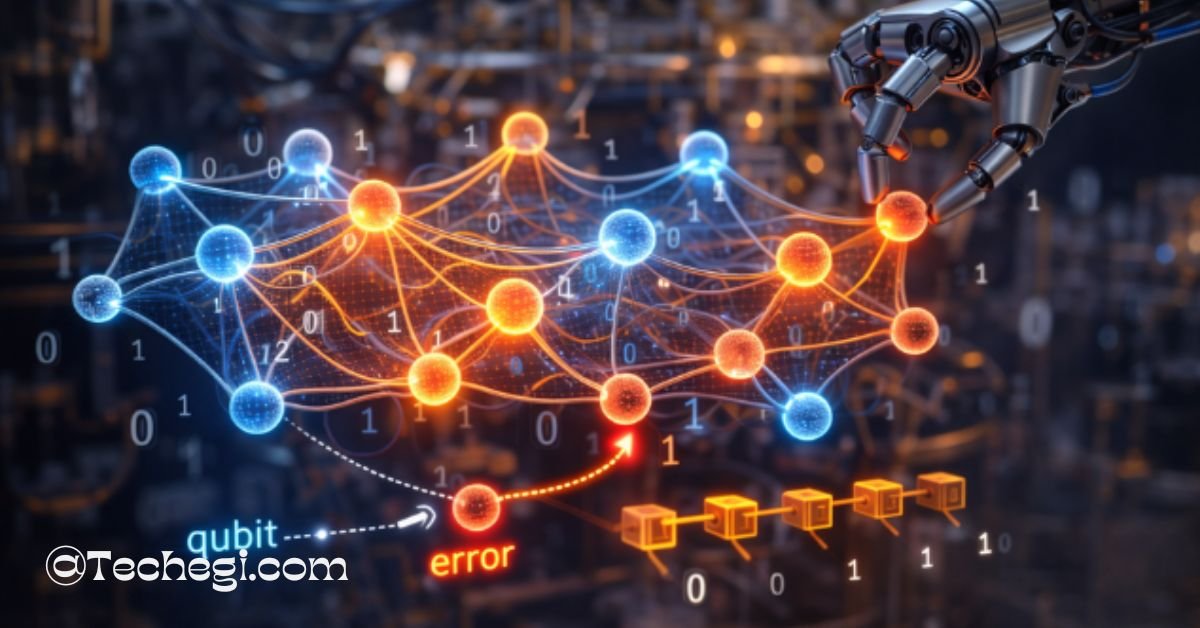
Quantum computing has the potential to revolutionize industries ranging from drug discovery to financial modeling. However, its practical deployment remains limited by one fundamental challenge: errors caused by unstable qubits.
These errors are particularly prevalent in today’s Noisy Intermediate-Scale Quantum (NISQ) devices, where hardware is powerful but inherently imperfect. To bridge this gap between experimental devices and fully fault-tolerant systems, researchers are increasingly turning to S-NISQ Quantum Error Correction.
This approach is designed to improve the reliability of quantum computations by mitigating noise and operational errors without demanding the massive hardware overhead of traditional error correction.
By combining partial error suppression, advanced decoding algorithms, and hybrid classical-quantum strategies, S-NISQ Quantum Error Correction allows near-term quantum devices to perform meaningful and accurate computations.
In this article, we’ll explore what S-NISQ Quantum Error Correction is, how it works, its applications, challenges, and its role in shaping the future of quantum technology.
Understanding the NISQ Era and Its Limitations
The term NISQ—or Noisy Intermediate-Scale Quantum—refers to the current generation of quantum processors. These machines contain tens to hundreds of qubits but cannot yet achieve full fault-tolerance due to high error rates, short coherence times, and hardware constraints. Unlike classical bits, qubits can exist in superpositions and become entangled, which allows them to perform complex calculations. However, these properties also make qubits extremely fragile, leading to errors from environmental noise, cross-talk, and imperfect gate operations.
In this context, S-NISQ Quantum Error Correction becomes essential. Traditional error correction methods require enormous numbers of physical qubits to encode a single logical qubit, which is not feasible for NISQ-era devices. Instead, S-NISQ strategies optimize for realistic hardware limits, enabling error mitigation while using significantly fewer resources. These methods are particularly valuable for computations that require multiple layers of entanglement or deep circuits, where even minor errors can propagate and invalidate results.
Researchers have also emphasized the role of hybrid classical-quantum systems. Classical processors continuously monitor error syndromes, decode likely error patterns, and adjust quantum operations accordingly. This integration allows S-NISQ Quantum Error Correction to function effectively on existing hardware while still preparing for future fault-tolerant quantum architectures.
What Is S-NISQ Quantum Error Correction?
S-NISQ Quantum Error Correction is a set of techniques designed to reduce computational errors in NISQ devices without requiring the full overhead of traditional fault-tolerant quantum computing. The “S” in S-NISQ is often interpreted as Scaled or Structured, reflecting its focus on adapting error correction to realistic hardware constraints.
Unlike full-scale error correction, which can demand hundreds of physical qubits per logical qubit, S-NISQ techniques aim to suppress errors just enough to extract meaningful results. This makes it practical for devices with limited qubit counts. Core strategies include:
- Partial qubit encoding, where logical qubits are represented using fewer physical qubits.
- Noise mitigation methods, such as zero-noise extrapolation and probabilistic error cancellation.
- Ancilla-based detection, which allows errors to be inferred indirectly without disturbing quantum states.
By combining these approaches, S-NISQ Quantum Error Correction can extend the reliability of quantum circuits in domains such as quantum chemistry, optimization problems, and machine learning. This ensures that near-term quantum devices can deliver real-world results even before fully fault-tolerant systems are available.
Key Techniques in S-NISQ Quantum Error Correction
Implementing S-NISQ Quantum Error Correction requires careful adaptation of error mitigation and detection methods. One widely used approach is surface codes, which involve interleaving data qubits with ancilla qubits. Ancilla qubits detect errors indirectly through repeated measurements, preserving the quantum state of the data qubits. Classical decoders then analyze the measurement patterns and apply corrections.
Other techniques include:
- Zero-Noise Extrapolation: Running circuits at varying noise levels and extrapolating the results to predict outcomes in an ideal, noise-free scenario.
- Probabilistic Error Cancellation: Modeling hardware noise as a probability distribution to counteract errors statistically.
- Symmetry Verification: Checking quantum states against expected symmetry properties and discarding results that violate them.
These methods collectively allow NISQ devices to maintain functional reliability without requiring full fault-tolerance. The key difference is that S-NISQ approaches accept residual errors, balancing error reduction with practical feasibility.
Comparison: S-NISQ vs Traditional Quantum Error Correction
| Feature | S-NISQ Quantum Error Correction | Traditional Fault-Tolerant Quantum Correction |
| Physical qubits per logical qubit | Low (practical for current devices) | High (hundreds or thousands) |
| Error suppression | Partial, pragmatic | Near-complete |
| Circuit complexity | Adapted for shallow, noise-aware circuits | Can support deep, complex circuits with sufficient qubits |
| Classical integration | Hybrid, real-time decoders essential | Requires powerful classical control but primarily focused on logical qubits |
| Practical applicability | Near-term, real hardware | Long-term, future hardware |
This table highlights why S-NISQ Quantum Error Correction is uniquely suited for NISQ-era devices. It prioritizes real-world performance and usability, whereas traditional methods target theoretical fault tolerance that current devices cannot achieve.
Applications of S-NISQ Quantum Error Correction

S-NISQ Quantum Error Correction is not just a theoretical concept—it has tangible benefits for practical quantum applications:
- Quantum Chemistry Simulations: Modeling molecular interactions with quantum computers is extremely sensitive to errors. S-NISQ techniques enable more accurate calculations of molecular energies and chemical reactions.
- Optimization Problems: Industries like logistics, finance, and supply chain management benefit from quantum optimization algorithms such as QAOA. Error suppression allows these algorithms to run deeper and produce more reliable results.
- Quantum Machine Learning: Quantum neural networks and kernel-based methods require precise computations. S-NISQ strategies help maintain accuracy despite hardware noise.
In each of these areas, S-NISQ Quantum Error Correction bridges the gap between experimental capabilities and practical results, accelerating adoption and research progress.
Challenges in Implementing S-NISQ Quantum Error Correction
While promising, S-NISQ Quantum Error Correction faces several ongoing challenges:
- Scalability: As qubit counts grow, error correction overhead increases, and classical decoding becomes computationally intensive.
- Hardware Connectivity: Limited qubit interactions constrain the implementation of entangling gates needed for error detection.
- Measurement Errors: Repeated ancilla measurements can themselves introduce errors, requiring sophisticated decoding strategies.
- Verification: For large circuits, classical simulation to confirm error correction effectiveness is often impossible.
Addressing these challenges requires ongoing research into faster decoders, better circuit design, and more efficient hybrid quantum-classical algorithms. These improvements will determine how widely S-NISQ Quantum Error Correction can be applied in real-world scenarios.
The Future of S-NISQ Quantum Error Correction
The long-term goal of quantum computing is fully fault-tolerant systems. However, S-NISQ Quantum Error Correction provides a vital transitional solution. Techniques developed today inform the design of future architectures, revealing which codes, decoders, and circuit structures are most practical.
Near-term quantum systems will continue to rely on hybrid quantum-classical approaches, where S-NISQ methods handle quantum operations while classical processors manage error decoding. As qubit quality and coherence improve, the performance of these systems will continue to rise, enabling broader applications in chemistry, finance, optimization, and machine learning.
Researchers currently refining S-NISQ techniques are effectively writing the roadmap for quantum computing in the NISQ era, ensuring that quantum devices can deliver tangible value today while preparing for the scalable, fault-tolerant systems of the future.
FAQs
1. What is S-NISQ Quantum Error Correction?
It is a set of practical techniques that reduce errors in NISQ quantum devices, combining partial qubit encoding, noise mitigation, and classical decoding without requiring full fault-tolerant architectures.
2. How does S-NISQ differ from traditional quantum error correction?
Traditional methods aim for near-complete error suppression with large qubit overhead, while S-NISQ focuses on reducing errors just enough for meaningful computations on current hardware.
3. Why can’t quantum computers use classical error correction?
Quantum states cannot be copied due to the no-cloning theorem, so classical error correction methods don’t apply. S-NISQ uses entanglement and ancilla qubits to detect errors indirectly.
4. Which applications benefit most from S-NISQ Quantum Error Correction?
Quantum chemistry simulations, optimization algorithms like QAOA, and quantum machine learning tasks benefit directly from S-NISQ error suppression.
5. When will S-NISQ enable practical quantum advantage?
For specialized tasks like small molecule simulations or optimization problems, near-term quantum devices may show practical advantage within the next 3–5 years.
Conclusion
S-NISQ Quantum Error Correction is a critical innovation for the current era of quantum computing. By addressing noise and operational errors in NISQ devices, it allows quantum systems to perform meaningful computations despite hardware limitations. This approach combines partial qubit encoding, noise mitigation, and hybrid classical-quantum methods to bridge the gap between experimental devices and fully fault-tolerant systems.
As hardware improves and qubit counts increase, the insights gained from S-NISQ techniques will inform the design of next-generation quantum computers. For researchers, engineers, and technology enthusiasts, understanding S-NISQ Quantum Error Correction is essential to grasp how quantum computing is evolving today and where it is headed in the near future.